In development · not yet released
Two full tanks.
One honest figure.
Brimwise logs your fill-ups and your business trips, then tells you what the car really returns and what a mile really costs. It runs on iPhone and Mac, and your data stays in your own iCloud.
Fuel economy can only be measured between two completely full tanks. Everything else is an average of guesses.
Most apps quietly average whatever they have
Put £20 in and drive off, and there is no way to know how much fuel that £20 actually replaced. The only measurement that means anything runs from one brimmed tank to the next: that distance, that fuel. Brimwise holds to it, which means some rows legitimately have no figure at all.
-
A partial gives no figure
Splash and dash is fine. Mark it a partial and its fuel rolls into your next full tank. Nothing is lost and nothing is wrong.
-
Your first fill is a baseline
There is nothing to measure against yet, so it shows no economy. Your first real figure lands on your second full tank.
-
A forgotten fill breaks the chain
Miss one and the interval either side is unmeasurable. Brimwise draws the break rather than averaging across it and hoping.
The history is drawn, not hidden
Rather than printing a dash where a number cannot exist, Brimwise draws a graph down the edge of the list. Each fill is a node, and the shape of the node tells you what kind of measurement it is — or why there isn't one. Nothing here is red: a missing figure is a fact, not an error.
-
Commit
A full tank. It closes an interval and carries a real figure, measured against the last full tank above it.
-
Branch
A partial fill, sitting off the trunk. Its fuel merges into the full tank above it, where it counts towards that figure.
-
Root
The first fill for a vehicle. Hollow, and the trunk stops: there is no earlier tank to measure back to.
-
Severed
A fill was missed. The cut sits below the node, on the older side — that is the interval nothing can measure across. History below it stays valid.
What it looks like
Both light and dark are first-class in the app, so these show whichever one you are reading in. Every figure in them is real output from the same engine the app ships with.
-
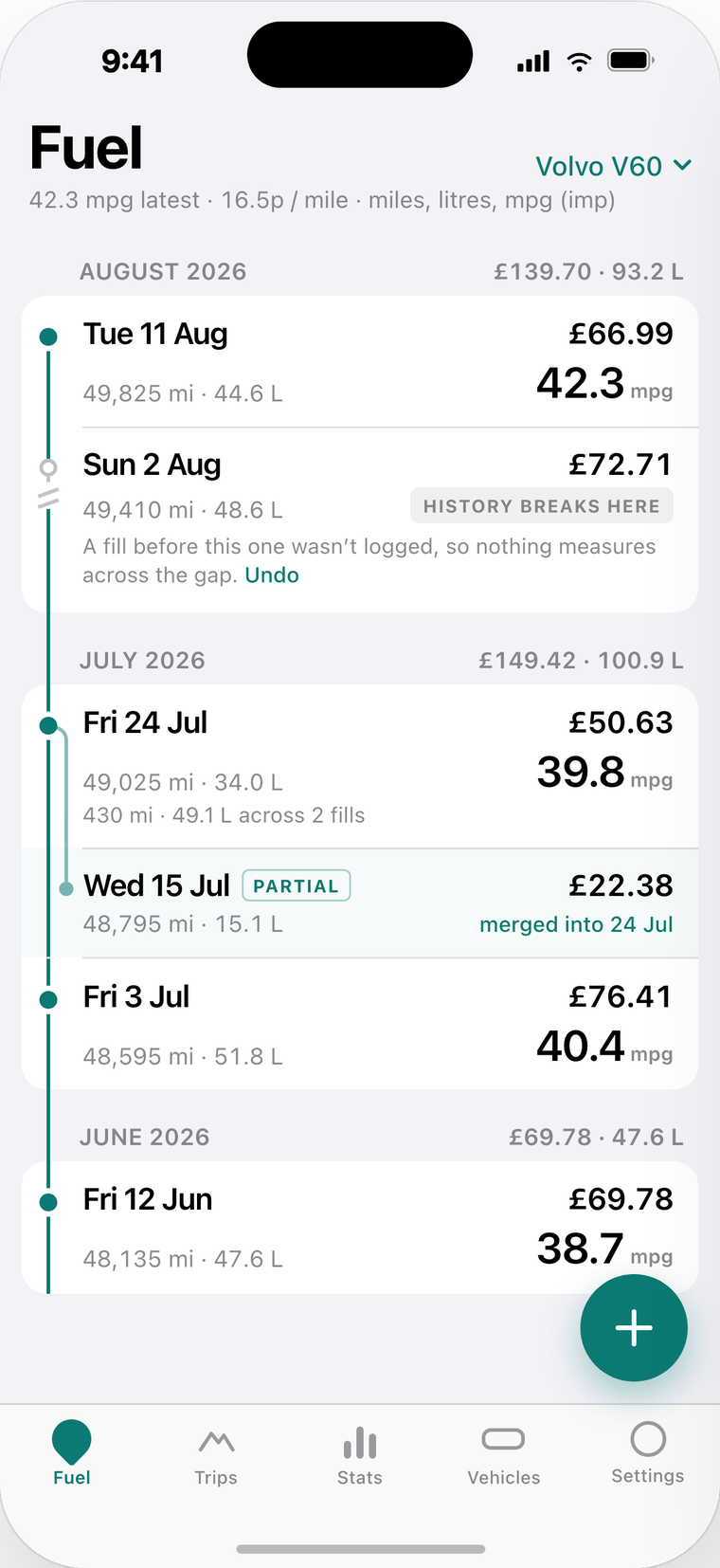
Fuel. Every fill, grouped by month, with the graph showing which of them a number is made of. -
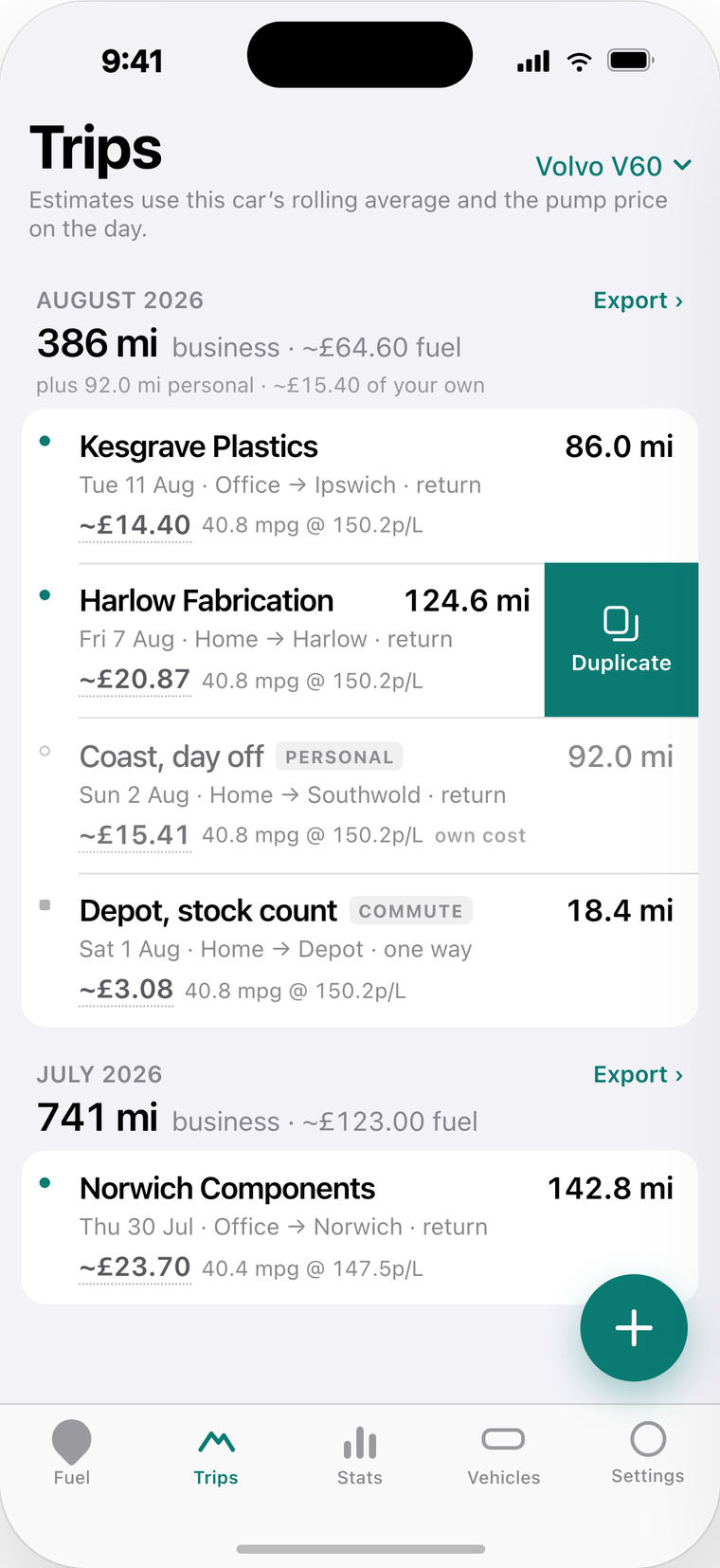
Trips. Each estimate prints the economy and pump price it came from, so you can check it. -
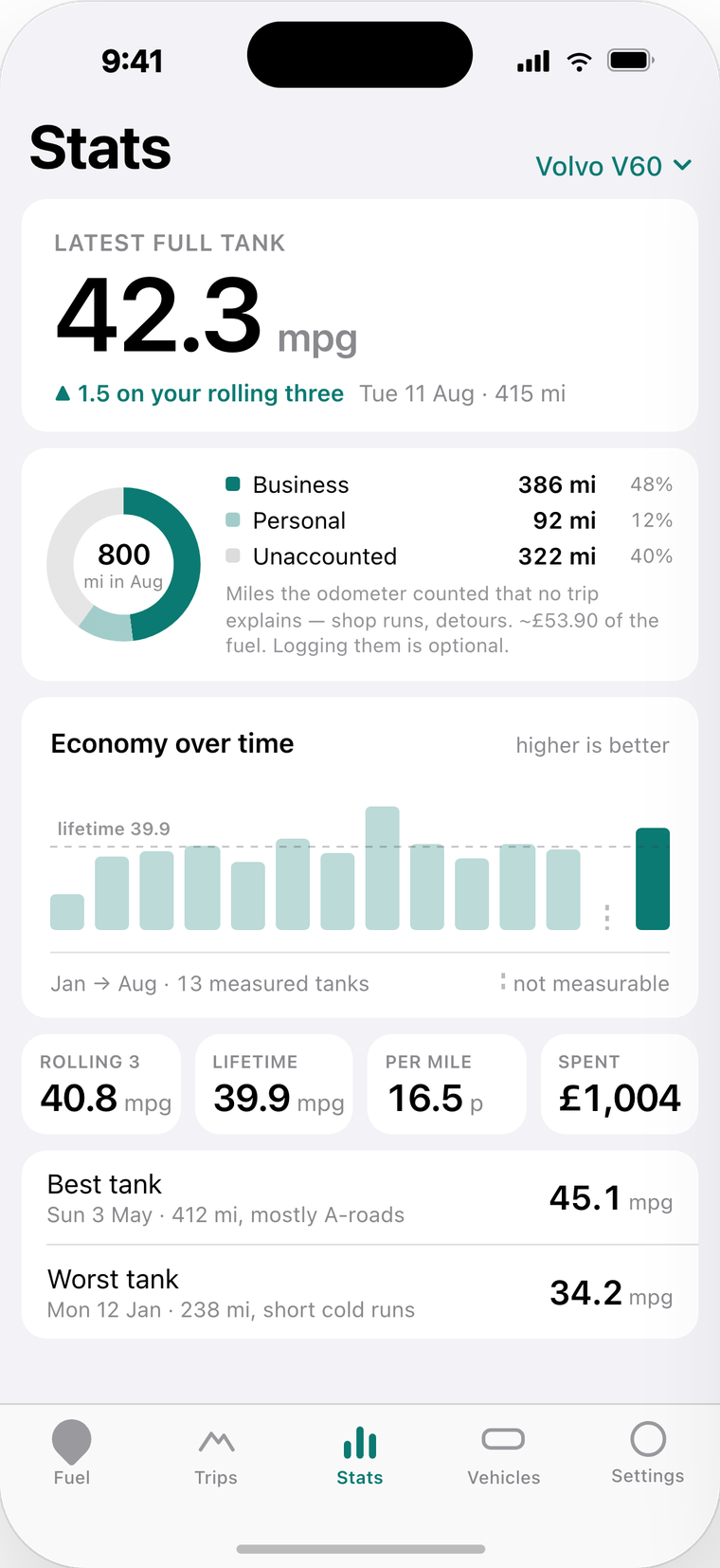
Stats. Measured tanks are bars; the ones that can't be measured are ticks, not gaps.


Claims that survive being questioned
Log the journeys you want to claim and Brimwise prices them from your own car's rolling average and the pump price you actually paid — then shows you the arithmetic on the row:
~£14.40 · 40.8 mpg @ 150.2p/L
Eighty-six miles, at this car's rolling average, at what fuel cost that week. Nothing rounded into a black box. Export a month as CSV — trips and fuel — and the totals reconcile, because they are derived from the same chain the rest of the app is.
Your data never reaches us
There is no Brimwise account, because there is no Brimwise server. Everything lives on your device and in your own iCloud private database, which Apple's design puts beyond our reach — we could not read it if we wanted to. No analytics, no crash reporting, no third-party SDKs, and no tracking on this website either.
Where it's up to
Brimwise has not been released. It is not on the App Store yet and there is no date — when there is something to announce, it will be here.
The first version covers fuel logging, trips, stats, vehicles, settings and CSV export, on iPhone and Mac, for petrol and diesel cars. Electric and plug-in hybrid support is designed but not built, and is on the roadmap rather than in the app.
Questions are welcome in the meantime — get in touch.